| View this email in your browser | |
 |
July 2026 |
 |
This month we discussThe 5 Most Common Pitfalls When Preparing Galvanized Metal for Painting |
 |
MPI Update
News from MPI HQ
A comprehensive review of the MPI Specification Manuals is now underway, with industry subject matter experts assessing each section for accuracy, relevance, and alignment with current practice. If you would like to share your expertise and participate in the review, please contact lucy.schneider@mpi.net to be added to the SME list.

The 5 Most Common Pitfalls When Preparing Galvanized Metal for Painting
Galvanized metal is widely used in commercial, industrial, and architectural applications because its zinc coating helps protect iron or steel from corrosion. That same protective layer, however, can make galvanized surfaces challenging to paint. Unless the surface is properly cleaned, prepared, and primed, coatings may struggle to bond and can fail prematurely.
Understanding the most common preparation mistakes can help specifiers, contractors, and facility teams reduce the risk of adhesion problems, blistering, peeling, and other costly coating failures. The five issues below are among the most frequent causes of poor performance when painting galvanized metal.
1. Overlooking the Smoothness of the Surface
Fresh galvanized metal is typically very smooth and has little natural surface profile for paint to grip. Without adequate mechanical or chemical preparation, even a high-quality coating may sit on the surface rather than bond to it. To improve adhesion, the galvanized surface should be lightly abraded by an appropriate abrasive blast method or prepared with an etching primer before coatings are applied.
2. Failing to Remove Surface Contaminants
Surface cleanliness is essential before any coating system is applied. Dust, grease, oil, shop soil, and other contaminants can create a barrier between the coating and the galvanized substrate. In some cases, lubricants used during fabrication may remain on the surface of galvanized components and may not be obvious during a visual inspection. These residues must be removed through proper cleaning procedures so the primer can form a reliable bond.
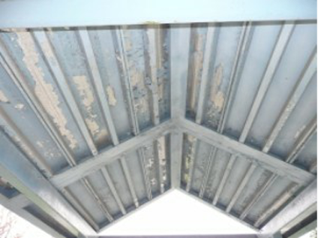
Skipping this step can lead to localized adhesion loss or widespread coating failure, particularly in environments where the finished surface will be exposed to moisture, abrasion, or frequent handling.
3. Ignoring White Rust
The zinc layer on galvanized metal is designed to corrode preferentially, helping protect the underlying steel or iron. When galvanized components are exposed to moisture during storage, shipping, or installation, the zinc corrosion product may appear as a white, powdery deposit commonly known as white rust.
White rust must be addressed before painting because it can interfere with primer adhesion and contribute to early coating breakdown. Mild cases can often be removed by carefully brushing the surface with a nylon brush and a solution of ammonia and lukewarm water. More severe conditions may require additional surface preparation before coating work proceeds.
4. Missing Supplier-Applied Surface Treatments
Galvanized products are sometimes treated before storage or transit to limit the formation of white rust. These treatments can be helpful for temporary protection, but they may also interfere with coating adhesion if left on the surface. Because they are not always visible, assuming the metal is ready to paint can be a costly mistake.
Before coating begins, confirm whether the galvanized material has received a passivation treatment, oil, chromate, or another protective surface treatment. Since practices vary by supplier, the galvanizing shop should be consulted for recommended removal and preparation methods.
5. Choosing the Wrong Primer—or Skipping Primer Altogether
Priming is one of the most important steps in painting galvanized metal. Most topcoats are not designed to bond directly to the zinc surface, so a suitable primer is needed to create an adhesion bridge between the substrate and the finish coat. Skipping primer, or selecting one that is incompatible with galvanized metal, can result in peeling, delamination, or poor long-term durability.
Although cementitious primers were commonly used in the past, they are now seldom used in the paint and coatings industry. Modern alternatives include solvent-based and water-based bonding primers. An epoxy primer may also be suitable in some systems, although epoxy primers typically require an abrasive blast-cleaned surface.
Key takeaway: Successful coating performance on galvanized metal depends on more than selecting the right paint. The surface must be clean, free of corrosion products and protective treatments, properly profiled, and matched with a compatible primer. Careful preparation at the start helps prevent avoidable coating failures later.
MPI Training Pass results

Congratulations to the Latest MPI Certified Students
Essentials of Paint and Painting Technology
- Kevin Wesley Shear, Benjamin Moore
- Robert Chesne, Alpine painting and sandblasting
- Keith Perrenoud, Spectrum Paint
- Brynn Lollar, Benjamin Moore
- Anthony Roy, Benjamin Moore
Professional Tip
Before painting galvanized metal, always confirm the surface is clean, properly profiled, free of white rust or protective treatments, and paired with a compatible primer to help ensure strong adhesion and long-term coating performance.